
Lightllm Architecture#
The core design of lightllm is multi-process collaboration. Each process is responsible for a module, and multi-process collaboration is carried out through zmq and rpc. lightllm includes the following modules:
Http Server : Responsible for receiving requests
Metric Server :Responsible for recording the performance indicators of system operation
Health Server :Responsible for monitoring the health of system operations
Router : Responsible for scheduling requests
Visual Server : Responsible for handling multimodal requests
Cache Manager Server :Responsible for managing the cache of inference results of multimodal information
Model Backend :Responsible for managing model inference for a single device. There can be several
Below we will explain the important modules one by one.
Http Server#

When we focus on Http Server, we can see its role in the lightllm system as shown in the figure above. At runtime, it is mainly responsible for:
Receiving API Requests
For system query requests, collaborate with
Metric ServerandHealth Serverto retrieve relevant information.For plain text requests, tokenize the text, wrap it as a plain text request, and send it to the
Router.For multimodal requests, obtain the MD5 hash of the image data, use the MD5 hash to request a cache from the
Cache Manager Server, store the image data in the cache, tokenize the text, and package the text along with the multimodal information into a multimodal request to be sent to theVisual Server.
Router#
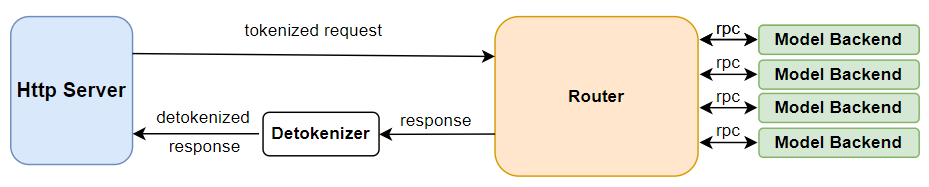
After the Router receives a request from the HttpServer, it is mainly responsible for storing the request and request scheduling. Specifically, it is responsible for:
Receiving requests sent by the
HttpServerorVisual Serverand placing them into the request queue.Deciding whether the current round should be
prefillordecode.If it is a
prefillround, determining which requests toprefill.If it is a
decoderound, determining which requests todecode.
Tip
For the detailed scheduling algorithm, please refer to: Efficient Router.
Model Backend#
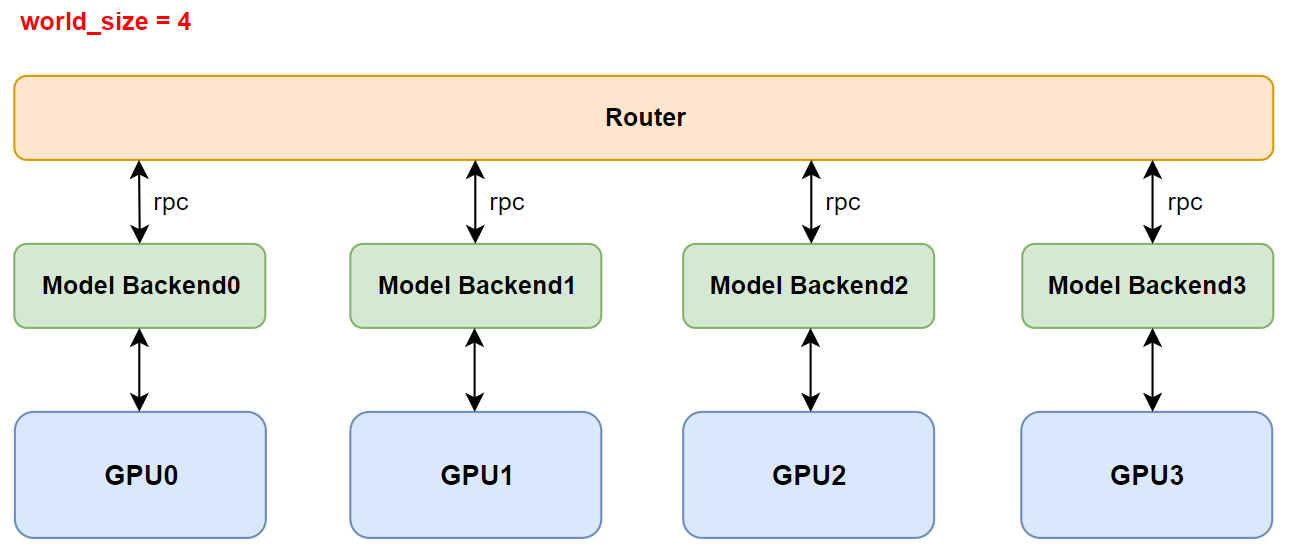
After the Router decides which requests to use for prefill or decode, the ModelBackend determines how to process these requests. The ModeBackend in the lightllm\server\router\model_infer\mode_backend\base_backend.py directory is the base class for all backends. By understanding its key functions, you can learn the main responsibilities of the backend:
init_model: Parses the model file to determine which model class fromlightllm-new-docs\lightllm\modelsto use.prefill_batch: Performsprefillon a batch of data.decode_batch: Performsdecodeon a batch of data.
Each backend has a model that represents an independent model class, and a tp_rank that represents a device. There can be several backends. The model class is responsible for the actual computation on the device, and the TpPartBaseModel in lightllm\common\basemodel\basemodel.py is the base class for all model classes, supporting tensor parallelism.
Tip
For a detailed introduction to the model classes, please refer to the How to Add New Model Support section.
Visual Server 和 Cache Manager Server#
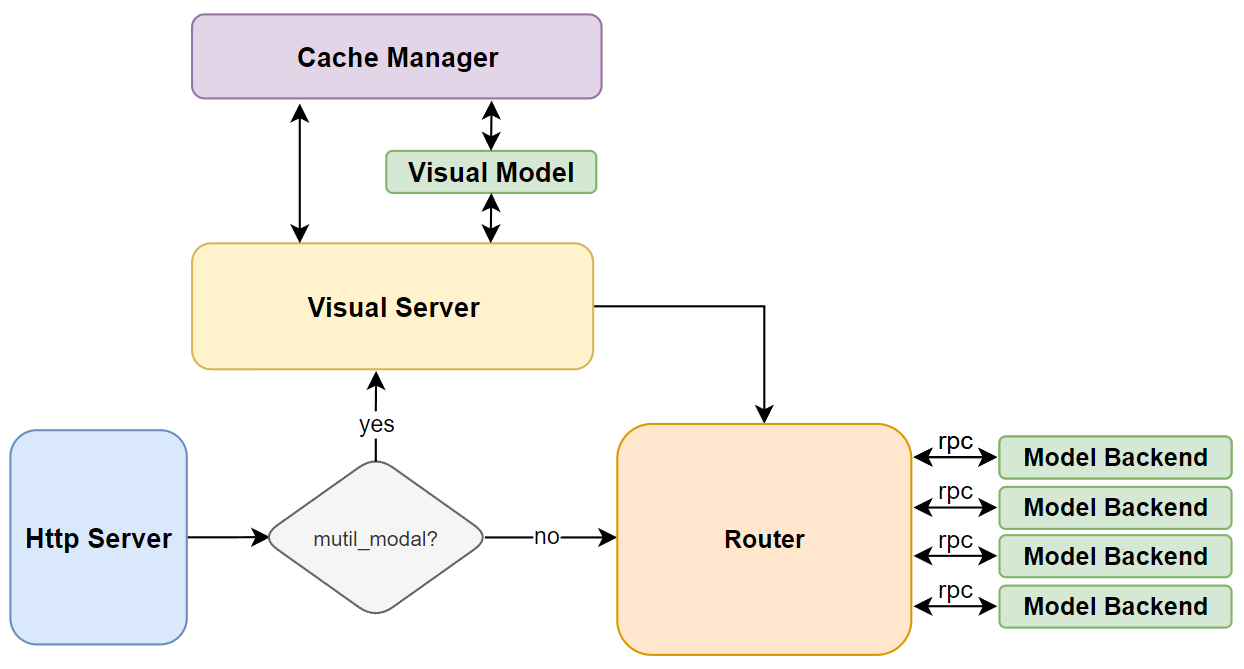
The Visual Server and Cache Manager Server are specifically designed to support the inference of multimodal models. The Visual Server is responsible for encoding image information in multimodal models, while the Cache Manager Server handles caching the original image data and the encoded feature data. This cache is stored in the host’s shared memory to reduce redundant memory reads across multiple processes and to avoid repeated encoding of image data.